Extending the Life of Your Commercial Kitchen Equipment: A Proactive Preventive Maintenance Checklist
Commercial kitchen equipment represents one of the single largest capital investments for restaurant owners, hospitality managers, and food service facilities. In high-volume culinary operations, appliances operate under continuous stress—exposed to extreme heat, airborne grease, mineral deposits, and round-the-clock usage. Without structured maintenance, equipment degrades rapidly, leading to sudden breakdown during peak service, inflated utility bills, health department citations, and premature capital replacement.
Adopting a proactive maintenance framework extends asset lifespans, maintains energy efficiency, and protects operational profitability.
Industry Terminology Explained
Before implementing an equipment maintenance schedule, understanding several foundational facilities and engineering concepts helps clarify daily operational requirements:
- Preventive Maintenance (PM): Scheduled, routine inspection and servicing of equipment to prevent unexpected breakdowns and extend asset operating life, as opposed to reactive maintenance (fixing equipment only after it fails).
- MEP Systems (Mechanical, Electrical, and Plumbing): The core building utility infrastructure that powers, waters, and vents commercial appliances. Equipment longevity relies heavily on correctly balanced MEP connections.
- Limescale (Scale) Build-Up: Hard mineral deposits (calcium and magnesium) left behind by heating hard water inside steam tables, ice machines, and commercial dishwashers. Excess scale acts as an insulator, forcing heating elements to work harder and fail prematurely.
- Airflow Clearance & Static Pressure: The required physical space surrounding refrigeration units and exhaust systems to allow proper heat dissipation. Restricted airflow causes compressors and motors to overheat.
Proactive Commercial Kitchen Equipment Checklist
To keep commercial kitchens running smoothly, maintenance tasks should be divided across key functional equipment categories:
1. Refrigeration & Cold Storage
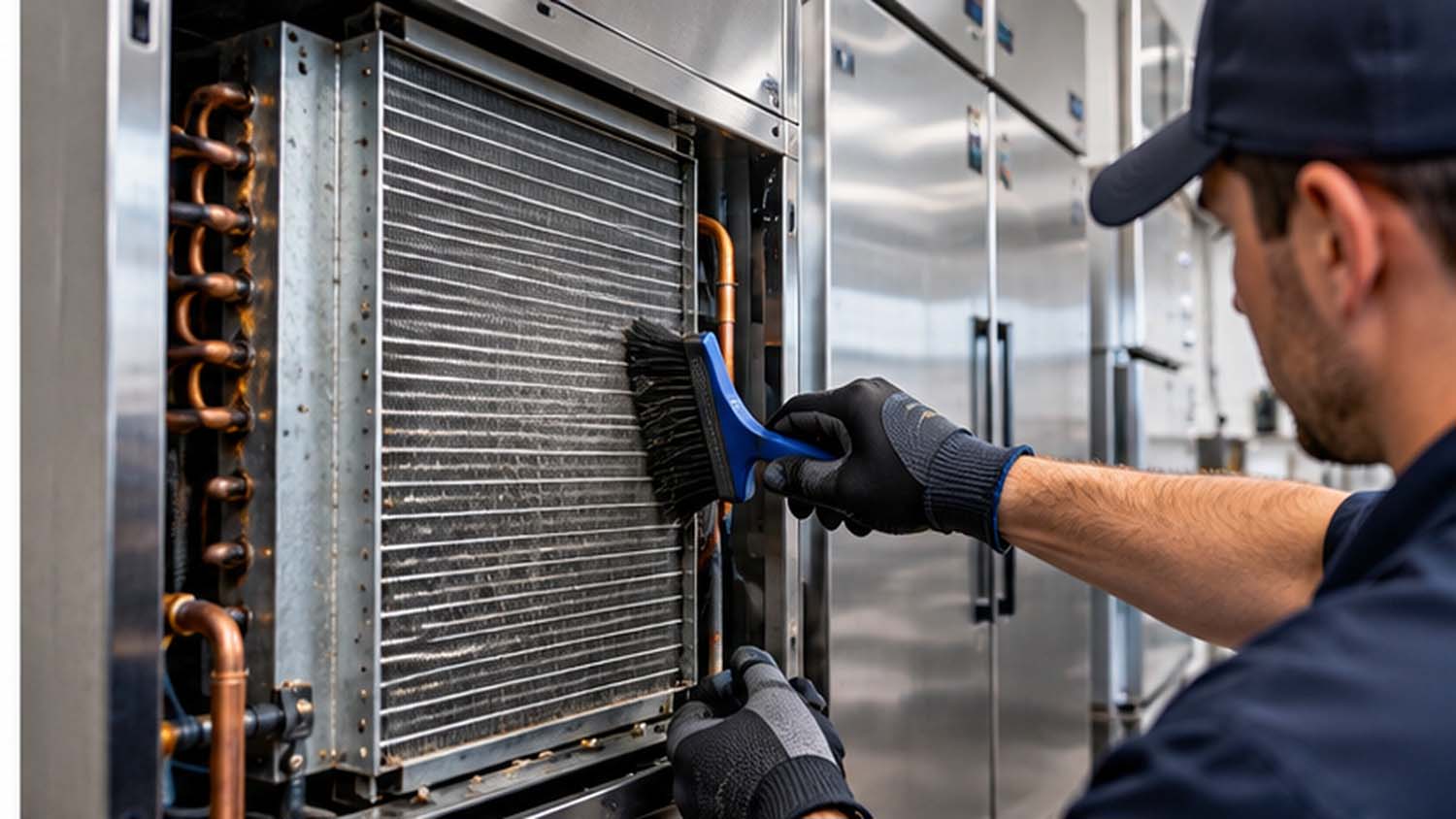
- Clean Condenser Coils (Monthly): Airborne grease and dust coat cooling coils, causing compressors to run hotter and pull higher electrical amperage. Vacuum and brush coils regularly.
- Inspect Door Gaskets (Quarterly): Cracked or loose flexible rubber door seals allow ambient warm air to enter, causing frost accumulation and forcing compressors to run non-stop.
- Clear Condensate Drain Lines (Quarterly): Flush drain pans and lines to prevent standing water, microbial growth, and ice build-up in walk-in freezers.
2. Cooking Line & Hot Equipment
- Calibrate Thermostats (Semi-Annually): Ovens, deep fryers, and griddles drift in temperature calibration over time, leading to inconsistent food preparation and excess fuel consumption.
- Degrease Burners & Pilot Assemblies (Weekly): Clogged gas ports lead to uneven flame distribution and inefficient gas combustion.
- Filter and Change Fryer Oil (Daily/Weekly): Carbonized food particles degrade oil heating elements and degrade product quality.
3. Ventilation & Fire Safety Systems
- Clean Grease Filters (Weekly): Wash baffle filters to maintain design exhaust airflow (CFM) and reduce fire hazards in exhaust ductwork.
- Inspect Fan Belts & Bearings (Quarterly): Check tension on roof exhaust fan belts and lubricate fan bearings to prevent motor burnout.
- Verify ANSUL & Auto-Shutoff Interlocks (Semi-Annually): Ensure fire suppression nozzles are aligned and fuel gas shutoff valves trigger during testing.
4. Warewashing & Plumbing Infrastructure
- Delime Dishwashers & Steamers (Monthly): Run manufacturer-approved descaling solutions through boiler tanks and wash arms to eliminate insulating mineral scale.
- Service Water Filtration Systems (Quarterly): Replace inline filter cartridges on ice machines and combi-ovens to prevent scale formation and pump erosion.
- Inspect Line Traps & Grease Interceptors (Monthly): Maintain point-of-use grease traps to prevent backup into kitchen drainage lines and city sewer mains.
Equipment Longevity Starts with Proper MEP Construction
Equipment failure is not always caused by appliance wear; it often stems from inadequate building infrastructure. An improperly sized electrical sub-panel can create voltage drops that burn out compressor motors. Similarly, inadequate gas supply line pressure or poorly designed hood ventilation can force equipment to operate outside engineered tolerances.
When updating or building out a commercial kitchen, partnering with an experienced general contractor ensures that all Mechanical, Electrical, and Plumbing (MEP) connections match exact equipment manufacturer specifications. Proper line sizing, dedicated electrical circuits, and correct spatial clearances during construction create the foundation for long-term equipment reliability.
Partner with PKNW Construction LLC
Whether you are planning a complete commercial kitchen remodel, optimizing your layout for efficiency, or upgrading building MEP infrastructure, PKNW Construction LLC provides technical expertise from pre-construction design through execution.
For assistance with your commercial facility planning or to discuss your upcoming project requirements, reach out to our team today. Feel free to use our Request a Quote tool at http://www.pknwconstruction.com or let us quote your project to help you build a reliable, code-compliant culinary space.